

TN Cooperative Bank has announced recruitment for 50 Assistant positions, offering excellent career opportunities for graduates seeking stable government banking careers in Tamil Nadu. The State Recruitment Bureau for Cooperative Societies (TNCOOPSRB) is conducting this recruitment drive with applications open until December 31, 2025. This comprehensive guide explores everything you need to know about the TN Cooperative Bank recruitment process, eligibility criteria, application procedures, and career benefits.
According to Reserve Bank of India’s cooperative banking statistics, cooperative banks play a crucial role in financial inclusion, particularly in rural and semi-urban areas of India. The TN Cooperative Bank system comprises a vital part of Tamil Nadu’s cooperative banking structure, serving communities through District Central Cooperative Banks and Primary Agricultural Credit Societies.
Understanding TN Cooperative Bank and Its Structure
The TN Cooperative Bank system represents Tamil Nadu’s extensive cooperative banking network, functioning under the Tamil Nadu Cooperative Societies Act, 1983. The Tamil Nadu State Apex Co-operative Bank (TNSC Bank) serves as the apex institution, headquartered in Chennai, providing banking services through a three-tier structure comprising State Cooperative Bank, District Central Cooperative Banks (DCCBs), and Primary Agricultural Credit Societies (PACS).
This cooperative banking framework plays a vital role in agricultural credit distribution, rural development financing, and financial inclusion initiatives across Tamil Nadu. According to National Bank for Agriculture and Rural Development (NABARD), cooperative banks provide approximately 60% of agricultural credit in rural India, making them essential for the agricultural economy.
The State Recruitment Bureau for Cooperative Societies (TNCOOPSRB) conducts recruitment for TN Cooperative Bank positions, ensuring transparent, merit-based selection processes. Established as per Section 74 of the Tamil Nadu Cooperative Societies Act and Rules 150-151 of Tamil Nadu Cooperative Societies Rules 1988, TNCOOPSRB operates independently to maintain recruitment integrity.
For detailed information about the current recruitment drive, candidates can review the official notification PDF published by TNCOOPSRB or visit the official TNCOOPSRB website.
Complete Vacancy Details for TN Cooperative Bank Recruitment 2025

The TN Cooperative Bank recruitment 2025 encompasses 50 total vacancies for Assistant positions, strategically distributed across different educational qualification categories. This targeted approach ensures diverse talent acquisition with specific expertise areas.
| Qualification Category | Number of Posts | Specific Requirements |
|---|---|---|
| Any Graduate Degree (any discipline) | 2 | Bachelor’s degree from UGC recognized university |
| Engineering/Technology (CS/IT/ECE) | 33 | Must have completed or be undergoing Cooperative Training + Computer knowledge |
| Bachelor’s Degree in Law | 2 | LLB from UGC recognized university |
| Bachelor’s Degree in Commerce | 9 | B.Com from UGC recognized university |
| Engineering/Technology (Civil/Electrical) | 4 | Degree from AICTE recognized institution |
| Total Assistant Posts | 50 | All require 10+2+3 pattern degree |
The largest segment—33 positions—targets Engineering graduates (Computer Science, Information Technology, or Electronics & Communication) who have completed or are currently undergoing Cooperative Training. This emphasis reflects the TN Cooperative Bank’s focus on digital transformation and technology integration in cooperative banking operations.
According to Indeed’s job market analysis, assistant positions in cooperative banks provide excellent career growth trajectories with clear promotion pathways to senior positions within 5-7 years of service.
Commerce graduates receive 9 positions, recognizing their specialized knowledge in accounting, finance, and commercial operations—skills directly applicable to banking functions. Law graduates fill 2 positions, providing legal expertise for documentation, compliance, and regulatory matters.
The qualification-specific allocation ensures the TN Cooperative Bank recruits professionals with diverse skill sets necessary for comprehensive banking operations. This strategic recruitment approach aligns with cooperative banking best practices emphasizing specialized competencies.
Visit Today Tamil Job’s comprehensive guide for detailed qualification-wise information and application tips.
Educational Qualifications and Eligibility Criteria
The TN Cooperative Bank maintains clearly defined eligibility standards ensuring candidates possess necessary educational backgrounds and competencies for banking operations. Understanding these requirements helps aspirants determine their eligibility before investing time in application preparation.
Educational Requirements by Category
Category 1: Any Graduate Degree (2 Posts)
Candidates must possess a bachelor’s degree in the 10+2+3 pattern from any recognized university in any discipline—Arts, Science, Commerce, Engineering, or any other field. According to University Grants Commission guidelines, the 10+2+3 pattern represents the standard Indian higher education structure comprising 10 years of schooling, 2 years of higher secondary, and 3 years of undergraduate education.
Category 2: Engineering/Technology – CS/IT/ECE (33 Posts)
This largest category requires:
- Bachelor of Engineering or Technology degree in Computer Science, Information Technology, or Electronics & Communication
- OR equivalent degree recognized by AICTE from any university or institution recognized by University Grants Commission
- MANDATORY: Must have completed OR currently be undergoing Cooperative Training
- Must possess knowledge in Computer Applications
Candidates currently undergoing cooperative training can apply but must submit successful completion certificates before appointment. This unique provision allows students in:
- 24th Postal Cooperative Training (2024-25)
- Full-time Cooperative Training at Tamil Nadu Cooperative Union centers (2025-26)
to apply with bonafide certificates from their training institutions.
Category 3: Bachelor’s Degree in Law (2 Posts)
Candidates must hold LLB degrees from universities or institutions recognized by University Grants Commission. This ensures legal expertise for documentation, contract management, loan agreements, and regulatory compliance within cooperative banking operations.
Category 4: Bachelor’s Degree in Commerce (9 Posts)
B.Com degrees from UGC recognized universities qualify candidates for these positions. Commerce education provides foundational knowledge in accounting, financial management, taxation, and auditing—directly applicable to banking operations.
Category 5: Engineering/Technology – Civil/Electrical (4 Posts)
Bachelor of Engineering or Technology degrees in Civil Engineering or Electrical Engineering (or equivalent) recognized by AICTE qualify candidates. These technical specialists support infrastructure development, building management, and electrical systems maintenance within cooperative banking institutions.
Tamil Language Proficiency
A critical eligibility criterion requires candidates to have studied and passed Tamil as a subject during:
- Final year of school education (Class 10 or Class 12), OR
- Degree-level studies
This requirement reflects the TN Cooperative Bank’s customer base, predominantly Tamil-speaking populations across rural and urban Tamil Nadu. Banking operations necessitate effective communication in the local language for customer service, documentation, and community engagement.
Computer Knowledge Requirement
All candidates must demonstrate basic computer application knowledge. While no specific certification is mandated, familiarity with:
- MS Office applications (Word, Excel, PowerPoint)
- Email and internet usage
- Basic data entry and database operations
is expected. According to Digital India initiatives, digital literacy has become essential for banking operations, with cooperative banks increasingly adopting core banking solutions and digital platforms.
Ex-Servicemen Special Provision
The TN Cooperative Bank extends special provisions for ex-servicemen who have served fifteen years in the Armed Forces and obtained Military Graduation Certificates issued by the Army. They can apply even without conventional university degrees, recognizing the valuable discipline, management skills, and work ethic that veterans bring to banking roles.
Age Limit and Relaxation Provisions
Age eligibility for TN Cooperative Bank recruitment follows structured guidelines ensuring candidates are at appropriate career stages for entry-level banking positions. As of July 1, 2025, candidates must meet the following age criteria:
| Category | Minimum Age | Maximum Age | Relaxation |
|---|---|---|---|
| General | 18 years | 32 years | None |
| SC/ST | 18 years | 37 years | +5 years |
| OBC/MBC/BCM | 18 years | 35 years | +3 years |
| PWD (Persons with Disabilities) | 18 years | 42 years | +10 years |
| Ex-Servicemen | 18 years | 37 years | +5 years |
| Destitute Widows | 18 years | 37 years | +5 years |
The minimum age of 18 years ensures candidates possess legal adulthood and sufficient maturity for banking responsibilities. The maximum age of 32 years for general category candidates balances providing opportunities to experienced professionals while maintaining career longevity potential within the organization.
Age relaxations follow Government of Tamil Nadu reservation policies ensuring social justice and equal opportunity. According to Constitutional provisions under Article 16(4), state governments can provide reservations and relaxations for backward classes, scheduled castes, scheduled tribes, and other disadvantaged groups.
Ex-servicemen receive preferential treatment recognizing their service to the nation. The five-year relaxation acknowledges military service years, allowing veterans to transition into civilian banking careers without age disadvantages.
Persons with disabilities receive ten-year age relaxation, recognizing additional challenges they may face in education and employment. This substantial relaxation demonstrates the TN Cooperative Bank’s commitment to inclusive employment practices.
Candidates should carefully calculate their age as of July 1, 2025, to determine eligibility. Birth certificates, school leaving certificates, or government-issued identity documents establish age proof during document verification.
Salary Structure and Career Benefits
Understanding compensation structures helps candidates evaluate TN Cooperative Bank opportunities against alternative career options. The bank offers competitive pay scales aligned with government banking sector standards while providing comprehensive benefits supporting long-term financial security.
Salary Structure for Assistant Posts
Pay Scale: 23640-96395
Starting Basic Pay: ₹23,640 per month
Maximum Basic Pay: ₹96,395 per month (after regular increments over career span)
These basic pay figures form the foundation of total compensation, with actual take-home significantly higher when including allowances. According to PayScale’s banking salary data for India, cooperative bank employees typically receive 35-45% additional compensation through various allowances beyond basic pay.
Allowances and Benefits
Dearness Allowance (DA): Adjusts periodically based on Consumer Price Index (CPI) variations, protecting purchasing power against inflation. As of 2025, DA for Tamil Nadu government employees averages 38-42% of basic pay, substantially increasing monthly earnings. The Tamil Nadu government revises DA twice annually—January and July—based on All India Consumer Price Index movements.
House Rent Allowance (HRA): Varies by posting location classification:
- X-Class cities (Chennai, Coimbatore, Madurai): 24% of basic pay (approximately ₹5,674 monthly)
- Y-Class cities (Salem, Trichy, Vellore): 16% of basic pay (approximately ₹3,782 monthly)
- Z-Class towns and rural areas: 12% of basic pay (approximately ₹2,837 monthly)
Estimated Monthly Take-Home Salary:
| Component | Amount (Approx.) |
|---|---|
| Basic Pay | ₹23,640 |
| Dearness Allowance (40%) | ₹9,456 |
| House Rent Allowance (varies) | ₹2,837 – ₹5,674 |
| Transport Allowance | ₹600 – ₹1,000 |
| Other Allowances | ₹1,000 – ₹2,000 |
| Gross Monthly Salary | ₹37,500 – ₹42,000 |
| Less: Deductions (PF, etc.) | ₹3,500 – ₹4,000 |
| Net Take-Home | ₹33,500 – ₹38,000 |
Other Benefits:
- City Compensatory Allowance (CCA) for metropolitan postings
- Medical Reimbursement for employee and family members
- Children’s Education Allowance
- Special Allowance for remote or difficult postings
- Festival advance and travel concessions
Provident Fund: Both employer and employee contribute 12% of basic salary plus DA. This accumulates substantial retirement corpus—conservative calculations suggest 25-year careers accumulate provident fund balances exceeding ₹35-40 lakhs for assistant-level employees.
Gratuity: Becomes payable after five years of continuous service, calculated at 15 days’ salary for each completed year. Upon retirement after 30 years, gratuity alone can amount to ₹10-15 lakhs, providing significant financial cushion.
Leave Benefits:
- Casual Leave: 12 days annually
- Earned Leave: 30 days annually (accumulative)
- Medical Leave: As per government rules
- Maternity Leave: 180 days (for female employees)
- Paternity Leave: 15 days (for male employees)
Career Progression: Assistants can expect promotions to Senior Assistant positions within 5-7 years, Head Clerk positions within 10-12 years, and eventually Officer positions through departmental examinations. Officers joining at junior scales can reasonably reach senior management positions within 15-20 years, effectively doubling or tripling compensation.
Application Process and Important Dates
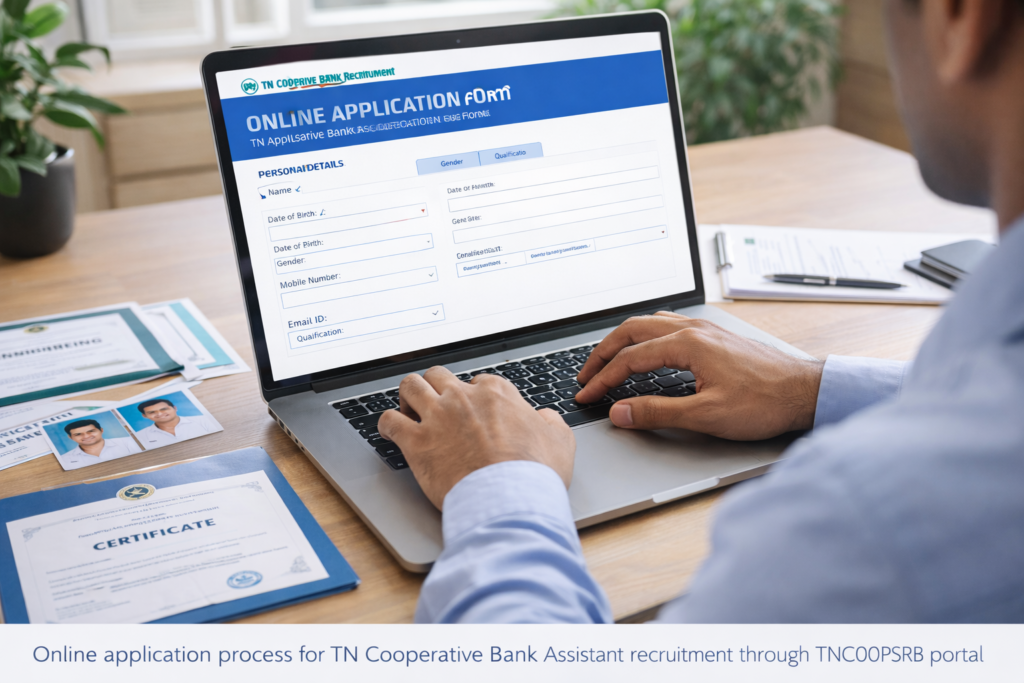
Successfully navigating the TN Cooperative Bank application process requires understanding procedural steps and adhering to timelines. The recruitment process is conducted entirely online through the State Recruitment Bureau for Cooperative Societies portal.
Timeline for TN Cooperative Bank Recruitment 2025
| Event | Date | Time |
|---|---|---|
| Notification Publication | December 12, 2025 | – |
| Online Application Opens | December 12, 2025 | 9:00 AM |
| Online Application Closes | December 31, 2025 | 5:45 PM |
| Application Fee Payment Last Date | December 31, 2025 | 5:45 PM |
| Admit Card Download | January 2026 (TBA) | – |
| Written Examination | January 24, 2026 | 10:00 AM – 1:00 PM |
| Answer Key Release | January 2026 (TBA) | – |
| Result Declaration | February 2026 (TBA) | – |
| Interview Schedule | March 2026 (TBA) | – |
Candidates should note these dates are subject to official confirmation. Regularly checking the official TNCOOPSRB website ensures staying updated on any schedule modifications or important announcements.
Step-by-Step Application Procedure
Step 1: Visit Official Website
Navigate to www.tncoopsrb.in, the official portal of the State Recruitment Bureau for Cooperative Societies. The homepage displays current recruitment notifications with prominent “Apply Online” links for active recruitment drives.
Step 2: Register Personal Details
Click the “Apply Online” button for the TN Cooperative Bank Assistant recruitment. Enter basic registration information including:
- Full name (as per educational certificates)
- Valid email ID (for correspondence)
- Active mobile number (for SMS updates)
- Date of birth
- Gender
The system generates a Provisional Registration Number and Password, sent via email and SMS. Preserve these credentials carefully as they’re required for all subsequent logins.
Step 3: Complete Application Form
Log in using registration credentials and systematically complete all application sections:
Personal Information: Name, father’s/mother’s name, date of birth, gender, nationality, community/caste category, religion, marital status
Contact Details: Permanent address, communication address, email, mobile number, alternative contact
Educational Qualifications: Degree details (university, year of passing, percentage), qualification category selection, Tamil language study proof, computer knowledge, cooperative training status (if applicable)
Additional Information: Ex-servicemen status (if applicable), persons with disability certificate details (if applicable)
Use the “Save and Next” feature to preserve information while working through multiple sections. This allows completing applications across multiple sessions without data loss.
Step 4: Upload Required Documents
Prepare and upload scanned copies of required documents meeting specified technical standards:
- Recent Photograph: Passport-size color photo (200×230 pixels, 20-50 KB, JPG format)
- Signature: Black ink signature on white paper (140×60 pixels, 10-20 KB, JPG format)
- Educational Certificates: Degree certificate, marksheets (PDF format, maximum 500 KB each)
- Community Certificate: SC/ST/OBC certificate if claiming reservation (PDF, maximum 500 KB)
- Tamil Study Certificate: Marksheet showing Tamil as subject (PDF, maximum 500 KB)
- Cooperative Training Certificate: Bonafide certificate if currently undergoing training (PDF, maximum 500 KB)
- Disability Certificate: If applicable (PDF, maximum 500 KB)
- Ex-Servicemen Certificate: If applicable (PDF, maximum 500 KB)
According to Tamil Nadu e-Governance standards, maintaining specified file sizes and formats ensures proper system processing and document retrieval during verification stages.
Step 5: Pay Application Fee
Application fees must be paid before final submission:
- General Category: ₹500
- SC/ST/PWD/Destitute Widows: ₹250
Payment methods:
- Central Cooperative Bank Branch Counter: Download and print the bank pay-in-slip generated after form completion. Visit any Tamil Nadu Central Cooperative Bank branch, pay the fee, and obtain a receipt. Scan the receipt and upload it in the application portal.
- Online Payment through TNSC Portal: Click “Pay using TNSC” button, redirecting to the Tamil Nadu State Cooperative Bank payment gateway. Pay using debit cards, credit cards, net banking, or UPI. Note the payment reference number (starting with DU…) for future reference.
Bank transaction charges are candidate-borne. According to National Payments Corporation of India regulations, digital payment gateways typically charge 0.5-1.5% convenience fees.
Step 6: Final Submission and Confirmation
After completing all sections and uploading documents, preview the entire application. Verify every detail carefully—corrections become impossible after final submission. Click “Final Submit” to complete the application process.
Download and print the completed application form and fee payment receipt for personal records. The system sends email confirmation with application number to the registered email address.
Examination Pattern and Syllabus
The TN Cooperative Bank employs computer-based testing to assess candidates across multiple competency areas relevant to banking operations. Understanding examination structure helps aspirants prepare strategically, allocating study time proportionate to each section’s weightage and difficulty.
Examination Structure
| Component | Questions | Marks | Duration | Medium |
|---|---|---|---|---|
| Reasoning Ability | 40 | 34 | 180 minutes | English & Tamil |
| Numerical Ability | 40 | 34 | (Combined) | (Bilingual) |
| General Knowledge | 40 | 34 | ||
| Tamil | 40 | 34 | ||
| Computer Knowledge | 40 | 34 | ||
| Total | 200 | 170 | 180 minutes | – |
The examination employs negative marking with 0.25 marks deducted for each incorrect answer. This makes blind guessing counterproductive—candidates should attempt questions only when reasonably confident about answers. With 200 questions in 180 minutes, candidates have an average of 54 seconds per question, requiring efficient time management.
Detailed Subject-Wise Syllabus
Reasoning Ability (40 Questions, 34 Marks)
This section tests logical thinking, pattern recognition, and analytical capabilities through:
- Puzzles and seating arrangements (linear, circular, floor-based)
- Syllogisms and logical deduction
- Coding-decoding patterns (letter, number, mixed)
- Blood relations and family trees
- Direction sense and distance calculations
- Number and alphabetical series
- Data sufficiency problems
- Statement and assumptions/conclusions
- Input-output problems
According to cognitive assessment research, reasoning tests effectively predict job performance in analytical roles requiring problem-solving and decision-making abilities essential for banking operations.
Numerical Ability (40 Questions, 34 Marks)
Mathematical competencies essential for banking operations:
- Arithmetic: Percentages, ratios and proportions, averages, profit and loss, simple and compound interest, time and work
- Number systems and simplification (BODMAS, surds, indices)
- Data interpretation from tables, bar graphs, pie charts, and line graphs
- Time and work problems with efficiency variations
- Time, speed, and distance calculations
- Partnership and mixture-alligation problems
- Basic mensuration (area, volume, perimeter)
General Knowledge (40 Questions, 34 Marks)
Focuses on:
- Current affairs (national and international) from past six months
- Banking sector developments: RBI policies, financial inclusion schemes, digital banking initiatives
- Tamil Nadu state information: geography, rivers, districts, major cities, historical landmarks
- Indian economy: budget highlights, GDP, inflation, major economic policies
- Government schemes: central and state welfare programs
- Sports: recent tournaments, awards, champions
- Books and authors, important days
- Science and technology: recent discoveries, space missions, innovations
Tamil Language (40 Questions, 34 Marks)
Evaluates Tamil proficiency through:
- Comprehension passages (புரிந்துகொள்ளுதல்) with questions testing understanding
- Grammar (இலக்கணம்): சொல்வகை, தொடர் அமைப்பு, பிழை திருத்தம், உயிர் மெய், மொழி பெயர்ப்பு
- Vocabulary (சொற்பொருள்): synonyms (ஒருபொருட் சொற்கள்), antonyms (எதிர்ச்சொற்கள்)
- Tamil literature basics: திருக்குறள், கம்பராமாயணம், பழமொழிகள், நாட்டுப்புறக் கதைகள்
- Translation skills (English to Tamil and Tamil to English)
- Idioms and proverbs (முகவுரை மற்றும் பழமொழிகள்)
Computer Knowledge (40 Questions, 34 Marks)
Examines digital literacy and banking technology:
- Computer fundamentals: generations, types, characteristics
- Input-output devices: keyboard, mouse, monitor, printer, scanner
- Hardware components: CPU, RAM, ROM, hard disk, motherboard
- Operating systems basics: Windows, Linux functions
- MS Office applications: Word processing, spreadsheets, presentations
- Internet and email: web browsers, search engines, email protocols
- Computer networking: LAN, WAN, network topologies
- Cybersecurity: viruses, malware, antivirus, firewall, encryption
- Banking technology: NEFT, RTGS, IMPS, UPI, mobile banking, core banking solutions (CBS)
Selection Process and Interview Guidelines
The TN Cooperative Bank employs a comprehensive two-stage selection process ensuring candidates possess both technical competencies and personal attributes suitable for banking careers.
Stage 1: Written Examination (85% Weightage)
The computer-based test constitutes the primary selection hurdle. Candidates must achieve minimum qualifying marks in individual sections and overall aggregate scores. Cut-off marks vary by qualification category and reservation category (General/OBC/SC/ST/PWD), determined based on difficulty level and candidate performance distribution.
The written examination carries 85% weightage in final merit calculation. According to psychometric testing principles, objective examinations provide reliable, valid assessment of cognitive abilities, knowledge, and aptitudes required for job performance.
Examination will be conducted in Computer-Based Test (CBT) mode at designated centers across Tamil Nadu. Candidates must bring printed admit cards and valid photo identity proofs to examination centers.
Stage 2: Personal Interview (15% Weightage)
Candidates clearing written examination cutoffs receive interview calls via email to registered addresses. Interview schedules are typically announced 2-3 weeks before dates, allowing candidates time for preparation and travel arrangements.
Interview panels assess:
- Communication Skills: Clarity of expression, language proficiency (Tamil and English), articulation of thoughts, listening skills
- Banking Knowledge: Understanding of cooperative banking principles, current banking trends, financial inclusion, digital banking
- General Awareness: Current affairs, social issues, economic developments, Tamil Nadu specific knowledge
- Personality Traits: Confidence, body language, interpersonal skills, problem-solving approach, stress management
- Career Motivation: Interest in cooperative banking, understanding of cooperative movement, long-term career goals, commitment to rural/cooperative sector service
Panel composition typically includes:
- Senior officers from TN Cooperative Bank or District Central Cooperative Banks
- Representatives from the Registrar of Cooperative Societies Department
- Subject matter experts in banking and cooperation
- Technical specialists for specialized qualification categories
Candidates must carry original documents for verification:
- Educational certificates (degree, marksheets, school certificates showing Tamil study)
- Community certificate (if claiming reservation)
- Cooperative training completion certificate (for engineering category candidates)
- Disability certificate (if applicable)
- Ex-servicemen certificate (if applicable)
- Photo identity proof (Aadhaar, PAN Card, Voter ID, Passport, Driving License)
Document discrepancies lead to candidature rejection regardless of written examination and interview performance.
Final Merit List Preparation
Final selection considers combined performance in written examination (85% weightage) and interview (15% weightage). The TN Cooperative Bank prepares separate merit lists for each qualification category and reservation category (General/SC/ST/OBC/MBC/PWD).
Merit Calculation Example:
Written Exam Score: 140/170 marks
Written Exam Weightage: 140 × 0.85 = 119 points

Interview Score: 40/50 marks
Interview Weightage: 40 × 0.15 = 6 points

Total Merit Score: 119 + 6 = 125 points
Selections occur in descending order of total merit scores within each category until vacancies are filled, subject to:
- Medical fitness certification
- Document verification confirmation
- Police verification clearance (character and antecedents)
- Satisfactory background checks
Selected candidates receive provisional appointment orders with joining instructions. Training programs orient new employees to cooperative banking operations, policies, procedures, and organizational culture before assuming regular duties.
Career Growth and Development Opportunities
Beyond initial recruitment, the TN Cooperative Bank offers structured career progression pathways enabling motivated employees to advance through organizational hierarchies while developing professional capabilities.
Assistants progress through clearly defined career stages:
Years 0-5: Assistant position with incremental salary increases, exposure to various banking operations including customer service, account management, loan processing, and documentation.
Years 5-10: Eligible for promotion to Senior Assistant positions through time-bound advancement and satisfactory performance evaluations. Responsibilities increase to include supervision of junior staff and handling complex banking transactions.
Years 10-15: Advancement to Head Clerk or Chief Clerk positions managing branch operations, coordinating staff activities, and ensuring compliance with banking regulations.
Years 15-20: Opportunity to enter Officer cadre through departmental examinations conducted periodically. Officer positions involve branch management, credit appraisal, policy implementation, and strategic planning.
According to career development research in banking, cooperative banks provide excellent growth trajectories with clearly defined promotion criteria combining seniority, performance assessment, and examination-based merit evaluation.
Professional Development Opportunities
The TN Cooperative Bank sponsors employees for various training programs and certifications:
- Cooperative Management Training: Advanced diplomas and certificates from VAMNICOM (Vaikunth Mehta National Institute of Cooperative Management), NCUI (National Cooperative Union of India), and state-level cooperative training centers
- Banking Skills Development: Programs in credit management, risk assessment, financial analysis, and audit procedures
- Computer and Technology Training: Digital banking, core banking systems, cybersecurity awareness, and emerging financial technologies
- Customer Service Excellence: Communication skills, conflict resolution, customer relationship management
- Leadership Development: Management principles, team building, decision-making, and strategic planning for officers aspiring to senior positions
Additional Benefits
Job Security: Government-backed cooperative banking positions offer exceptional job security. Unlike private sector employment vulnerable to economic downturns or corporate restructuring, cooperative bank positions provide stable, long-term careers with pension benefits and post-retirement security.
Work-Life Balance: Cooperative banks generally maintain regular banking hours (10 AM to 5 PM on weekdays, 10 AM to 1 PM on Saturdays) with Sundays and government holidays as offs. This predictable schedule supports better work-life balance compared to private sector banking with extended working hours.
Social Impact: Working in cooperative banking provides opportunities to contribute meaningfully to rural development, agricultural financing, and financial inclusion. Employees directly support farmers, small businesses, and underserved communities, creating positive social impact beyond personal career advancement.
Transfer Policies: Employees may be posted anywhere within their district or across Tamil Nadu based on organizational requirements. Transfer policies typically consider years of service at current location, family circumstances, medical grounds, and mutual transfer requests with other employees.
Preparation Strategy for Success
Systematic preparation significantly improves chances in the TN Cooperative Bank recruitment. With only 50 positions available, competition will be intense. Candidates should develop structured study plans addressing each examination component while allocating time proportionate to individual strengths and weaknesses.
Foundation Building (Weeks 1-2)
Begin with comprehensive coverage of fundamental concepts across all subjects. For Reasoning Ability, understand various question types—puzzles, seating arrangements, coding-decoding, syllogisms—with practice sets for each category. Master basic patterns and logical relationships.
For Numerical Ability, strengthen arithmetic fundamentals: percentages, ratios, averages, profit-loss, simple and compound interest. Build speed in calculations using shortcuts and tricks. Practice data interpretation from various graph types.
English and Tamil language preparation should emphasize grammar rules, vocabulary building through word lists and reading, and comprehension practice through diverse text types. For Tamil specifically, review இலக்கண basics and read Tamil newspapers daily.
Computer Knowledge benefits from hands-on experience with software applications alongside theoretical concept learning. Create notes on banking technology terms and their meanings.
General Awareness demands current affairs tracking from past six months. Maintain notebooks documenting important events, policy announcements, and banking developments with monthly review cycles.
Intensive Practice (Weeks 3-4)
Transition from concept learning to extensive practice through mock tests replicating actual examination conditions. Time management becomes crucial—200 questions in 180 minutes means averaging 54 seconds per question.
Practice tests reveal time allocation strategies, identifying sections requiring more/less time investment. Some candidates may excel at quick reasoning but struggle with lengthy comprehension passages, suggesting time reallocation strategies.
Analyze incorrect answers understanding not just right options but also why chosen alternatives were wrong. This diagnostic approach prevents recurring mistakes. According to cognitive psychology principles, analyzing errors strengthens learning more effectively than mere correct answer memorization.
Attempt full-length mock tests under strict time conditions at least 5-7 times before examination. This builds stamina for sustained concentration while familiarizing with computer-based testing interfaces.
Subject-Specific Strategies
For Reasoning: Focus on high-weightage topics like puzzles and seating arrangements. Practice diverse question types daily. Develop systematic approaches to different puzzle formats.
For Numerical Ability: Master percentage-based calculations (appear frequently in profit-loss, SI/CI). Practice data interpretation extensively as these questions consume more time. Learn shortcut methods for calculations.
For General Knowledge: Stay updated with banking sector news, RBI policies, government schemes. Create monthly current affairs compilations. Focus on Tamil Nadu-specific questions (geography, governance, schemes).
For Tamil: If you’re weak in Tamil, dedicate extra time. Practice reading Tamil newspapers and magazines to improve fluency. Review grammar rules systematically. Practice translation exercises.
For Computer Knowledge: Create flashcards for banking technology terms. Understand practical applications of concepts rather than rote memorization. Review basic computer operations and MS Office features.
Final Week Strategy
The week before examination should focus on revision rather than new topic learning. Review formula sheets, important shortcuts, and compiled notes. Attempt one final comprehensive mock test three days before examination, using results to identify last-minute revision priorities.
Avoid intensive studying on the examination eve—light revision coupled with adequate rest ensures optimal mental freshness. According to sleep research, proper rest significantly impacts cognitive performance, memory consolidation, and decision-making abilities.
Prepare examination day requirements including printed admit card, photo identity proof, photocopies thereof. Verify examination venue location in advance, planning travel routes accounting for potential delays. Carry water bottle and light snacks (if permitted).
Common Mistakes to Avoid
Learning from others’ errors helps candidates avoid pitfalls that derail even well-prepared aspirants during the TN Cooperative Bank recruitment process.
Incomplete Applications: Rushing through application forms causes errors in personal details, educational qualifications, or qualification category selection. Such mistakes create verification mismatches, potentially causing disqualification despite clearing examinations. Carefully verify every entry before final submission, especially qualification category selection.
Wrong Qualification Category Selection: With only 50 positions distributed across five qualification categories, selecting the wrong category means competing for different vacancies than you’re eligible for. Engineering (CS/IT/ECE) candidates without cooperative training cannot apply in that 33-post category. Verify your exact qualification matches the selected category.
Missing Cooperative Training Certificate: Engineering graduates (CS/IT/ECE) applying for the 33-post category MUST submit cooperative training certificates (either completion or bonafide for ongoing training). Missing this document leads to automatic disqualification regardless of exam performance.
Poor Quality Document Uploads: Blurred photographs, illegible signatures, or improperly sized documents lead to application rejection during preliminary screening. Use quality scanners or cameras in good lighting. Preview uploaded images before submission, re-uploading if clarity seems questionable.
Missing Application Deadlines: Many candidates wait until December 31st (5:45 PM deadline), encountering technical difficulties, website congestion, or payment gateway issues. Apply at least 2-3 days before deadlines, providing buffer time for unexpected problems.
Ignoring Tamil Language Requirement: Candidates without Tamil language study during education often overlook this mandatory eligibility criterion. Verify Tamil study certificates before applying to avoid disqualification during document verification. Without Tamil language proof, application will be rejected.
Neglecting Negative Marking: Attempting every question regardless of certainty accumulates substantial negative scores. Strategic skipping of doubtful questions often yields better net scores than answering everything. Calculate thresholds—if confidence level below 60-70%, skipping typically proves safer than guessing.
Inadequate Time Management: Many candidates spend excessive time on difficult questions early in examinations, leaving insufficient time for easier questions appearing later. Quickly scan entire question papers initially, tackling comfortable questions first before returning to challenging ones with remaining time.
Insufficient Tamil Preparation: Non-Tamil medium educated candidates sometimes underestimate the Tamil section difficulty. With 40 questions carrying 34 marks, poor Tamil performance significantly impacts total scores. Dedicate adequate preparation time to Tamil language, especially if it’s your weaker area.
Last-Minute Interview Preparation: Selected candidates sometimes appear unprepared for interviews, lacking knowledge about cooperative banking principles or current sector developments. Begin interview preparation immediately after written examination, researching cooperative banking history, challenges, and Tamil Nadu’s cooperative movement.
Conclusion
The TN Cooperative Bank recruitment 2025 represents excellent opportunities for graduates seeking stable government banking careers in Tamil Nadu. Though limited to 50 positions, the recruitment accommodates diverse educational backgrounds through qualification-specific categories, ensuring merit-based selection of candidates with specialized expertise.
The largest allocation—33 positions for Engineering graduates (CS/IT/ECE) with cooperative training—reflects the sector’s digital transformation priorities. Commerce graduates (9 positions) bring financial expertise, while Law graduates (2 positions) contribute legal knowledge. The remaining positions accept any graduate degree, providing opportunities for candidates from all academic disciplines.
Competitive salary structures starting from ₹23,640 with comprehensive benefits including DA, HRA, provident fund, and gratuity, combined with government job security, make these positions highly attractive. The relatively accessible eligibility requirements—bachelor’s degrees with Tamil language proficiency—open opportunities for graduates across disciplines, though specific categories have additional requirements like cooperative training.
The selection process, while competitive given limited vacancies, remains transparent and merit-based. Candidates meeting eligibility criteria, preparing systematically across examination subjects, and approaching selection stages strategically significantly improve success probabilities. Given only 50 positions with potentially thousands of applicants, thorough preparation becomes essential.
Interested candidates should submit applications through the official TNCOOPSRB website before the December 31, 2025 (5:45 PM) deadline. Complete recruitment details, including qualification-specific requirements and examination guidelines, are available in the official notification PDF.
The TN Cooperative Bank system plays a crucial role in Tamil Nadu’s rural development, agricultural financing, and financial inclusion initiatives. Joining this sector offers meaningful work impacting communities while building stable, rewarding careers. With cooperative banking’s continued importance in financial inclusion and government support, demand for skilled professionals ensures long-term career sustainability.
Aspirants should seize this opportunity, preparing diligently while maintaining realistic expectations about competition levels given limited vacancies. Success in TN Cooperative Bank recruitment opens doors to fulfilling banking careers serving Tamil Nadu’s cooperative movement and rural development objectives. With proper preparation, strategic approach, and dedication, candidates can successfully compete for these prestigious positions.
Key Takeaways
- TN Cooperative Bank recruitment 2025 offers 50 vacancies for Assistant positions with qualification-wise distribution
- Online applications are open from December 12, 2025, to December 31, 2025 (5:45 PM) through the official website tncoopsrb.in
- The written examination is scheduled for January 24, 2026 (10:00 AM to 1:00 PM) as per the latest notification
- Educational qualifications vary by category: Engineering graduates with cooperative training (33 posts), Commerce graduates (9 posts), Law graduates (2 posts), and other categories
- Age eligibility ranges from minimum 18 years to maximum 32 years (as of July 1, 2025) with relaxations for reserved categories
- Application fee is ₹500 for General category and ₹250 for SC/ST/PWD/Destitute Widows
- Selection process includes online written examination (85% weightage) and personal interview (15% weightage)
- Starting salary is ₹23,640 with comprehensive benefits including DA, HRA, and provident fund contributions
Frequently Asked Questions
Q1: How many total vacancies are available in TN Cooperative Bank recruitment 2025?
The TN Cooperative Bank recruitment 2025 offers a total of 50 vacancies for Assistant positions. These are distributed across five qualification categories: 33 posts for Engineering graduates (CS/IT/ECE) with cooperative training, 9 posts for Commerce graduates, 4 posts for Engineering graduates (Civil/Electrical), 2 posts for Law graduates, and 2 posts for any graduate degree. All positions are for Assistant cadre in the cooperative banking sector under Tamil Nadu State Cooperative Bank system. Candidates should carefully check which qualification category they belong to before applying.
Q2: What is the last date to apply for TN Cooperative Bank recruitment 2025?
The online application window for TN Cooperative Bank recruitment 2025 closes on December 31, 2025, at 5:45 PM. Applications opened on December 12, 2025. Candidates must complete their application submission, including fee payment and document uploads, before this deadline. It is strongly advised to apply at least 2-3 days before the deadline to avoid last-minute technical issues, website congestion, or payment gateway problems. Late or incomplete applications will not be accepted under any circumstances. The written examination is tentatively scheduled for January 24, 2026.
Q3: Can Commerce graduates apply for Engineering category posts in TN Cooperative Bank?
No, Commerce graduates cannot apply for Engineering category positions in TN Cooperative Bank recruitment. Each qualification category is strictly defined with specific educational requirements. Commerce graduates (B.Com degree holders) can only apply for the 9 positions specifically allocated for Bachelor’s Degree in Commerce category. Similarly, Engineering graduates can only apply for their respective categories (33 posts for CS/IT/ECE with cooperative training, or 4 posts for Civil/Electrical). Attempting to apply in wrong categories will lead to disqualification during document verification. Candidates must carefully select the qualification category matching their actual degree.
Q4: Is cooperative training mandatory for all Assistant posts in TN Cooperative Bank?
No, cooperative training is mandatory only for the Engineering (Computer Science/Information Technology/Electronics & Communication) category which has 33 posts. This is the largest category and specifically requires candidates to have completed or be currently undergoing Cooperative Training. Other categories—Commerce (9 posts), Law (2 posts), Engineering Civil/Electrical (4 posts), and Any Graduate (2 posts)—do not require cooperative training. However, candidates in the engineering CS/IT/ECE category must submit either cooperative training completion certificates or bonafide certificates from training institutions if currently undergoing training. Without this, applications in that specific category will be rejected.
Q5: What is the examination pattern for TN Cooperative Bank Assistant recruitment?
The TN Cooperative Bank examination consists of 200 objective-type questions for a total of 170 marks, with a duration of 180 minutes (3 hours). The exam is available in both English and Tamil languages. It covers five sections: Reasoning Ability (40 questions, 34 marks), Numerical Ability (40 questions, 34 marks), General Knowledge (40 questions, 34 marks), Tamil (40 questions, 34 marks), and Computer Knowledge (40 questions, 34 marks). There is negative marking of 0.25 marks for each incorrect answer. The exam will be conducted online (computer-based test) at designated examination centers across Tamil Nadu on January 24, 2026.
Q6: Is Tamil language knowledge mandatory for TN Cooperative Bank jobs?
Yes, Tamil language proficiency is absolutely mandatory for all TN Cooperative Bank positions. Candidates must have studied and passed Tamil as a subject during their final year of school education (Class 10 or Class 12), OR during their degree-level studies. This requirement is strictly enforced as banking operations in Tamil Nadu’s cooperative sector require effective communication with predominantly Tamil-speaking customers in rural and semi-urban areas. Candidates without Tamil language study certificates will be disqualified during document verification, even if they clear the written examination and interview. The examination includes a dedicated Tamil section with 40 questions worth 34 marks, further emphasizing its importance.
Q7: What documents are required during TN Cooperative Bank application?
Candidates must upload scanned copies of the following documents during online application for TN Cooperative Bank recruitment: (1) Recent passport-size color photograph (200×230 pixels, 20-50 KB), (2) Signature on white paper with black ink (140×60 pixels, 10-20 KB), (3) Educational certificates – degree certificate and marksheets showing qualification (PDF, max 500 KB each), (4) Tamil language study certificate or marksheet showing Tamil as subject (mandatory), (5) Cooperative training certificate – completion or bonafide certificate for ongoing training (required for engineering CS/IT/ECE category only), (6) Community certificate if claiming SC/ST/OBC reservation, (7) Disability certificate if applicable, (8) Ex-servicemen certificate if applicable. Original documents must be carried to examination center and interview for verification.
Q8: What is the salary for TN Cooperative Bank Assistant positions?
The starting basic pay for TN Cooperative Bank Assistant positions is ₹23,640 in the pay scale of 23640-96395. The maximum basic pay can reach ₹96,395 with regular increments over the career span. In addition to basic pay, employees receive Dearness Allowance (38-42% of basic pay, approximately ₹9,000-10,000), House Rent Allowance (12-24% depending on posting location, approximately ₹2,800-5,600), Transport Allowance, Medical Reimbursement, and other allowances. Total monthly gross salary typically ranges from ₹37,500-42,000 for newly appointed assistants. After deductions (PF, etc.), net take-home salary ranges from ₹33,500-38,000. Provident fund contributions (12% by employer and employee), gratuity after 5 years, and structured career progression provide additional long-term financial security.
Q9: Can students currently doing cooperative training apply for TN Cooperative Bank?
Yes, students currently undergoing cooperative training can apply for TN Cooperative Bank recruitment with certain conditions. Specifically, students enrolled in the 24th Postal Cooperative Training (2024-25) or full-time Cooperative Training conducted at Tamil Nadu Cooperative Union’s Cooperative Management Centers (2025-26) are eligible to apply for the Engineering (CS/IT/ECE) category which has 33 posts. However, they must submit a bonafide certificate from their educational institution stating they are currently undergoing cooperative training at the time of application. Importantly, appointment orders will be issued only after they submit certificates of successful training completion. This provision applies only to the engineering category requiring cooperative training—other categories don’t have this option.
Q10: What is the selection process for TN Cooperative Bank recruitment 2025?
The TN Cooperative Bank selection process consists of two stages: (1) Written Examination carrying 85% weightage, which is a computer-based test with 200 objective questions covering Reasoning Ability, Numerical Ability, General Knowledge, Tamil, and Computer Knowledge, scheduled for January 24, 2026; and (2) Personal Interview carrying 15% weightage, where candidates’ communication skills, banking knowledge, personality traits, and suitability are assessed. Final merit lists are prepared based on combined scores from both stages (85% from exam + 15% from interview). Candidates must achieve minimum qualifying marks in individual exam sections and overall aggregate. Separate merit lists are prepared for each qualification category and reservation category. Selected candidates undergo document verification, medical examination, and police verification before receiving appointment orders.
